

Programs
Graduate Degree Programs
- Doctor of Philosophy in Business (PHDBUS)
- Master of Science in Computational Finance (MSCF)
- Master in Risk and Insurance Management
- Master of Marketing Communications
- Master of Science in Accountancy
- Master of Science in Entrepreneurship
- Master of Science in Marketing and Diploma in Marketing
- Master of Science in Financial Engineering
- Master of Science in Industrial Relations Management
- Master of Science in Industrial Relations Management and Diploma in Industrial Relations Management
MBA/DBA Programs
Diploma Programs
- Post-Graduate Diploma in Management (PGDM)
- Diploma in Entrepreneurship
- Diploma in Financial Engineering
- Diploma in Industrial Relations and Management
- Diploma in Marketing
Doctor of Philosophy in Business (PHDBUS)
48 units
The Doctor of Philosophy in Business (PHDBUS) Program at De La Salle University stands as a beacon of excellence, offering a specialized and research-driven approach to leadership strategies. Meticulously crafted for ambitious and self-driven individuals, this curriculum is designed to cultivate advanced research, leadership, and analytical skills, setting a new standard for academic and professional excellence.
Designed for students with an ardent interest in academia and a drive to formulate a perceptible impact in the private and public sectors, the PHDBUS is a transformative journey that transcends traditional education paradigms.
It is not just an academic pursuit—it is a transformative experience that prepares individuals to lead, innovate, and shape the future of business and society.
| PHBUS GO | Description |
|
PLO 1 |
Collaborate with various stakeholders to assess business environment and industry structure using theoretical or conceptual framework by undertaking ethical independent business research |
|
PLO 2 |
Validate existing and new business models, theories, and principles used in both research and practice |
|
PLO 3 |
Develop and lead research groups that apply complex research methods to foster collaboration and mentorship |
|
PLO 4 |
Produce innovative and sustainable research-based solutions, concepts, strategies, for industry-related issues through collaboration with industry leaders for the implementation and impact evaluation of said undertakings |
Admissions Procedure
- The student is required to undergo the university requirements in applying for the program. (Admissions Office Requirement ([email protected]) – c/o Mr. Raymond Gonzales’ Admissions Office)
- Entrance requirements will include a written examination to test quantitative ability and English proficiency in addition to the interview of Graduate Studies Coordinator and submission of one (1) published or publishable research output
Master of Science in Computational Finance (MSCF)
The Master of Science in Computational Finance Program is an intensive program geared towards educating students, investment professionals, and financial advisers to integrate mathematical and statistical models and techniques with financial theory and computer technology.
The program aims to prepare students, investment analysts, portfolio managers, and financial advisers:
-
- To have the necessary foundations in mathematics, statistics, finance, and computer science disciplines, and to apply these disciplines to the latest computer technology; and
- To meet the challenges and opportunities presented by the financial markets.
Admission Requirements
Applicants to the MS in Computational Finance must have:
- A bachelor’s degree in any of the following fields: mathematics, statistics, economics, accounting, management of financial institutions, computer science or engineering;
- satisfactory admission test scores
- satisfactory interview and essay results
- three years of relevant work experience
MSCF CURRICULUM
PRE-MSCF Courses / Unit
Economics for Finance (FNC5000) (3)
Business Law (BNG5000) (3)
Statistics for Finance (MSC5010) (3)
Financial Accounting (ACC5000) (3)
Mathematics of Finance I (FNC500M) (3)
Mathematics of Finance II (FNC501M) (3)
Methods of Research (BUS7050) (3)
IT Workshops
CORE COURSES
Ethics BUS8300) 3
Corporate Finance (FNC5020) 3
Corporate Valuation (FNC5140) 3
Multivariate Analysis (FNC512M) 3
Investment Analysis (FNC5130) 3
Time Series Analysis (FNC 519 M) 3
Trading Software and Program (FNC516M) 3
Securities Research (FNC518M) 3
Advanced Financial Management (FNC5170) 3
Portfolio Management (FNC5150) 3
ELECTIVES (Choice of two electives) 6
Written Comprehensive Examination (GSB600W) Or Thesis (GSB8510)
(Management Research, 3 units, required)
Total (excluding Pre-MSCF Courses) 36 units
Master in Risk and Insurance Management
PROGRAM GOALS:
The degree program core consists of risk management and parallel series of both life and non-life insurance management.
-
- To provide a mechanism for enhancing analytical skills by giving rigorous training in specific skills that are in great demand in the insurance sector, international agencies and private industry and commerce that focus on managing risks.
-
- To provide thorough knowledge on theoretical and application concepts in both life and non-life insurance management.
-
- To increase awareness in Insurance Management and its contribution to the society.
-
- To equip prospective managers with more efficient analysis and decision-making skills.
-
- To provide multi-facetted perspective in managing risks by applying a range of risk analysis techniques to technical and financial issues.
-
- To develop among professionals good value judgment and effective leadership skills toward sound problem-solving and decision-making activities.
THE CURRICULUM:
A Thesis degree program consisting of:
- 39 units of basic, core and elective courses
- Written Comprehensive Examination
- 6 units of Thesis Writing
- Fulltime: 7 – 8 trimesters
- Part-time: 8 – 10 trimesters
Basic Courses:
Life and Non-Life Insurance Management
This introductory course provides an overview of the entire process of managing life and non-life insurance companies including the prudent management of their investment in stocks, bonds, notes and other instruments.
Marketing and Communications
This course provides an understanding of the basic marketing principles and functions of marketing in the insurance industry.
Economics of Insurance
This course is a thorough review of both macro and microeconomics, with particular discussion on economic constraints and production possibilities, and market characteristics, structures and institutions.
Corporate Finance and Strategic Management
It covers environmental scanning, assessment, internal and external factors analysis, strategy recommendations and implementation. It will also cover capital budgeting techniques, working capital requirements, analysis of the financial statements of insurance companies, and an introduction to portfolio management and investment.
Legal Studies and Claims Management
A review of the insurance code of the Philippines, all other circulars passed that affect the insurance industry in general. This course is also designed to develop a practical working knowledge of the handling and management of claims, both commercial and personal lines.
International Insurance and Reinsurance
This course studies insurance markets from both general and international perspectives. It includes the nature and functions of reinsurance and the non-traditional methods of risk transfer.
CORE COURSES:
A. Life Insurance Track:
Risk Management and Treatments for Life Insurance
This course covers the nature and objectives of corporate risk management with primary consideration devoted to the recognition, evaluation and treatment of pure risks to which the life insurance corporation is exposed.
Life and Health Insurance
This course discusses the determination of human life values and the conservation of those values through personal and business life and health insurance.
Fundamentals of Actuarial Science
This course introduces practical applications of financial mathematics such as loan amortization and bond pricing, premium contingencies, basic life contingencies and determination of annuity insurance benefits and premiums.
Estate Planning and Liability Insurance
Applications of life and health insurance to business and estate planning situations with emphasis on current developments in retirement planning, business continuation and estate conservation.
B. Non-Life Insurance Track:
Risk Management and Treatments for Non-life Insurance
This course covers the nature and objectives of corporate risk management with primary consideration devoted to the recognition, evaluation and treatment of pure risks to which the non-life insurance corporation is exposed.
Marine, Property and Liability Insurance
This course focuses on the marine insurance association, marine hull and cargo insurances, clauses and policy forms, underwriting practice and marine claims. It also examines the structure of insurance markets and the financial management of property-liability insurance companies.
Applied Statistical Methods
This course focuses on statistical forecasting techniques such as regression, exponential smoothing and time series models, with particular emphasis on insurance applications.
Reinsurance
This course covers the fundamental reinsurance purchasing decisions, property liability program design and pricing, the impact of key reinsurance clauses, reinsurance claims and alternative risk transfer and securitization.
ELECTIVE COURSES:
Risk Management Information Systems
This course focuses on the examination of data collection and analysis methods for risk management decisions, analysis of qualitative and quantitative data to support transfer, retention and loss control decisions including loss trending, and evaluation of regulatory controls.
Portfolio Management and Underwriting
This course covers the fundamental difference between the skills required to manage a portfolio of insurance risks and those required to underwrite individual policies.
Fire and Casualty Insurance
This course covers fire insurance practice, underwriting, extra perils including all risks, general and industrial fire hazards, and preparation of plans and reports.
Suretyship
This course discusses the nature, concepts and principle of suretyship, and will include the different types of bonds, underwriting guidelines and claims.
Employee Benefit Plan Design and Financing
This course covers that rationale behind substantial budget commitments to employee benefits as well as employee benefit package designs and aspects of life insurance.
Visit the updated page.
Master of Science in Accountancy
The Master of Science in Accountancy (MSA) is designed to keep pace with recent technological and international advances. Recognizing the vast sources of financial and accounting information, its relevance is enriched by analyzing from the perspective of economic theory, quantitative techniques, and behavioral science. Valuable information is therefore made more meaningful to users of financial statements. This allows for greater corporate governance, ethical practices, and openness to challenges in the accounting profession.
Objectives of the Program
In response to challenges to the accountancy profession, the program aims to:
1. Provide quality financial analysis by incorporating economic theory, quantitative analysis, and research techniques in the study of accountancy;
2. Increase awareness of the role of corporate governance and ethics in the practice of accountancy
3. Incorporate the latest qualitative and quantitative techniques in the interpretation, analysis, and dissemination of accounting and financial statements;
4. Become an equal partner in business decision-making and rigorous research;
5. Utilize the knowledge and skills to become value oriented and responsible corporate citizens.
Course Requirements
The curriculum consists of basic courses (18) units, major courses (12 units), cognates (6 units), and thesis (6 units).
Basic Courses
Accountancy enrichment course
Statistics for business & economics
Microeconomic theory
Macroeconomic theory
Problems in financial reporting
Econometrics
Major Courses
Financial analysis
Philosophy of science and scientific methods
Empirical research in accounting
Financial economics
Cognates/Electives
Accounting for financial instruments
Accounting information technology
Economics of multinational operations
Issues in corporate finance/ investment
Ethics and corporate responsibility
Updates in management accounting and special topics
Organizational behavior
Final requirements for completion
Written comprehensive examination
Thesis
Admissions Requirements
1. A bachelor’s degree in accounting
2. Satisfactory admission test scores and interview results
3. Above average scholastic performance
4. English proficiency test
*Students are required to take 6-units English subjects unless they scored satisfactorily in the entrance examination essay.
LIST OF REQUIREMENTS
For Local Applicants
1. Application Form with 2×2 picture.
2.Original copy of Transcript of Records
3.Original Copy of NSO Birth Certificate
4.Transfer Credential (for non-DLSU graduate) 5.Two (2) Letters of recommendation (downloadable at DLSU website)
6.Updated Curriculum Vitae/Resume
7. Personal Statement containing Academic and Career Objectives
8.Two (2) pieces of 2”x 2” picture for testing permit
9. Certificate of good moral character from previous school/ employer at least six months from date of issuance
10.Photocopy of research output (for Ph.D. applicants only)
For International Applicants
1. Application form with 2″x 2″ picture (downloadable at DLSU website)
2. Photocopy of passport
3. Two (2) copies of Transcript of Records (Authenticated and Original copy)
4. Certificate of Graduation (with degree title and date of graduation)
5.Two (2) copies of Certificate of No Criminal Record (Authenticated and photocopy)
6.Two (2) Letters of Recommendation (form downloadable at DLSU website)
7.Curriculum Vitae or Resume
8. Personal Statement (format can be viewed from the DLSU website)
9.Photocopy of Research output (For PhD applicants only)
10. Two (2) pieces 2″x2″ recent picture for testing permit
Financial Aid
Scholarships are available to deserving students. Awarded on academic merit or financial need, these grants are generally good for one trimester and renewable thereafter. Part-time teaching positions are also available on an invitation basis.
Duration of the program
The program normally takes one year of three trimesters (full-time) or two years or six trimesters (part-time) to complete the coursework and about another year to accomplish the final requirements such as written comprehensive exam and the thesis.
A student is expected to complete all graduation requirements within a maximum residency period of eight years.
Contact Information
Graduate Admissions Office (GAO)
La Salle Hall Rm 101
2401 Taft Avenue
1004 Manila, Philippines
Tel. Nos.: (632) 303-1378 (direct line) or
(632) 524-4611 local 468 (trunk line)
Email: [email protected]
Website: [email protected]
Master of Science in Entrepreneurship (MSENT)
36 units
The Master of Science in Entrepreneurship program provides a rigorous pathway for aspiring, oriented entrepreneurs, with a particular focus on the dynamic landscape of small and medium-sized enterprises (SMEs) in the Philippines. Distinguished by its practical and immersive pedagogy, the program is structured over two years (six trimesters) of part-time coursework, followed by an additional year dedicated to final requirements, including a comprehensive examination, journal publication, and thesis. The culminating project emphasizes the design of a flexible corporate strategy—an essential element of the business plan—intended to attract capital, equity investors, venture capitalists, and other key stakeholders.
| MSENT GO | Description |
|
PLO 1 |
Collaborate with various stakeholders to assess business environment and industry structure using theoretical or conceptual framework by undertaking independent business research |
|
PLO 2 |
Formulate and execute strategic direction and action plan by analyzing, recommending, and justifying courses of action. Provide innovative and sustainable solutions to an identified challenge/issue and relate it to current field of study |
|
PLO 3 |
Demonstrate highly-effective managerial and leadership skills to be able to work effectively and independently in multi-disciplinary and multi-cultural teams, thereby fostering collaborative learning communities |
|
PLO 4 |
Generate new ideas, processes and systems abreast with economic trends to expand the knowledge and problem-solving skills in entrepreneurial undertakings |
Admissions Procedure
- The student is required to undergo the university requirements in applying for the program. (Admissions Office Requirement ([email protected]) – c/o Mr. Raymond Gonzales’ Admissions Office)
- Once the student admission result is released by admissions office, he/she will be interviewed by the department’s graduate program coordinator as one of the requirements to be admitted in the program.
- The graduate program coordinator will assess if the student is eligible to enroll the MSENT program. He or she is in charged in determining if the student needs to enroll additional writing subjects, such as Technical Writing 1 and Technical Writing 2.
Visit the updated page.
Master of Science in Financial Engineering and Diploma in Financial Engineering
The MSFE and DFE is a fusion of mathematics, statistics, information and computer technology to the study of finance. It is envisioned to be a highly competitive program that will equip students with a comprehensive set of tools to meet the requirements of a vibrant financial economy. It further seeks to identify and develop sound strategies and models that will meet the challenges of a dynamic financial environment amid competition, globalization, and advances in technology.
Duration of the Program
The Program normally takes two (2) years (six trimesters) on a part-time basis to complete the coursework. Another year is allotted to accomplish the final requirements such as the written comprehensive exam and the thesis.
Course Requirements
Basic/Course Courses 12 units
Major Courses 18 units
Cognates/Electives 6 units
Thesis 6 units
Total 42 units
Course Requirements
History of Finance
Traces finance from ancient history, the medieval times, the Industrial Revolution to the more contemporary theories such as the Miller-Modigliani propositions, Black-Scholes, Options, etc.
Calculus for Finance
Provides learning calculus as applied in finance. Requires extensive use of software applications and interactive modeling.
Financial Economics I
Introduces the theories and developments in individual and corporate valuation to general financial markets.
Advanced Statistics/Data Mining
Discusses detailed applications of various forecasting and data mining techniques.
Major Courses (3 units each)
Risk Management and Value at Risk
Analyzes the various determinants of risk and strategies used to manage risk, including hedging.
Derivatives and Options Pricing
Identifies and analyzes valuation of derivatives and other exotic securities.
Portfolio Management and Strategy
Provides the mathematical foundation and derivation of strategies in managing a portfolio.
Financial Controllership (3 units)
Provides a financial engineering perspective of controllership.
Treasury Operations (3 units)
Gives a view of treasury, emphasizing developing products for specific risks.
Methods of Research
Studies various techniques of financial engineering research.
Cognates/Electives (3 units each)
Financial Economics II
Provides a study of financial institutions and services and corporate governance. Continuation of Financial Economics I.
Applied Regression and Time Series Analysis
Presents programming applications of regression and time series analysis as applied to risk management strategies.
International Finance
Provides a study of international corporate finance and global portfolio management.
Special Topics in Financial Engineering
Provides a discussion forum of contemporary issues such as e-commerce, e-finance, e-banking, etc.
Linear and Non-linear Optimization
Provides frameworks for analyzing various linear and non-linear relationships in a finance environment.
Master of Science in Industrial Relations Management and Diploma in Industrial Relations Management
The MS and Diploma in IRM programs aim to develop competent and globally-oriented HRD professionals and practitioners for Philippine enterprises. It focuses primarily on the professional development needs of people who are involved in HRD work. Recognizing that graduate students will be best educated through contextual learnings, the Programs seek to utilize the “school-to-work” approach which integrates the theoretical and actual work experiences to optimize learning.
Specifically, the MS and Diploma in IRM Programs aim to enhance the knowledge, skills, and values of students on industrial relations management related to development, training, wage administration, health and safety, labor relations.
Admission Requirements
- A bachelor’s degree; preferably in Business/Legal Management
- Satisfactory admission test scores and interview results
- Scholastic records and two letters of recommendation
Curriculum
Basic Courses
Human Behavior in Organization
3 units
Statistics
3 units
Labor Economics
3 units
Research Methods
3 units
Major Courses
Pre-employment and Human Resources Development Program
3 units
Conditions of Employment and Wage Administration
3 units
Health, Safety, and Welfare Benefits and Post Employment
3 units
Management of Labor Unions and Collective Bargaining Agreements
3 units
Dispute Settlement
3 units
International Labor Laws
3 units
Cognates
Current Trends and Practices in IRM
3 units
Human Resource Information
3 units
Final Requirements for Completion
Written Comprehensive Examinations and Thesis/Research Projects
6 units
Total units required
42 units
Master of Science in Industrial Relations Management and Diploma in Industrial Relations Management
The MS and Diploma in Marketing Programs aim to prepare individuals with prior work experience or very satisfactory academic accomplishments for significant management responsibilities in the field of marketing, either in the private or public sector. It can also prepare individuals to join the teaching profession. A broad curriculum provides comprehensive exposure in all aspects of marketing. Students learn and apply theoretical marketing knowledge in a practitioner context, acquiring all of the skills necessary to remain competitive and advanced their careers in the Philippines and internationally.
The MS Marketing Program emphasizes active learning through case studies, “real-world” group, class discussion, and involvement with Philippine businesses.
Admission Requirements
- Admission Exam
- Undergraduate transcript and diploma
- Postgraduate transcript (if applicable)
- Three Character References (excluding relatives)
- Satisfactory interview results
Curriculum
Basic Courses
Marketing Management 3 units
Research Methods 3 units
Marketing Strategy and Practice 3 units
Statistics 3 units
Major Courses
Product Management 3 units
Pricing Strategies 3 units
Management of Marketing Channels 3 units
Integrated Marketing Communications 3 units
Consumer Issues and Behavior 3 units
Special Topics in Marketing 3 units
Industrial and Services Marketing 3 units
Cognates
Choices of two from the following:
Total Customer Management,
Global Marketing, Sales and Sales
Force Management, Public Relations
Management, Applied Marketing
Research, Methods of Teaching Marketing.
Final Requirements for Completion
Written Comprehensive Examinations
and Thesis/Marketing Research Projects 6 units
Total units required
42
DOCTOR OF BUSINESS ADMINISTRATION
- Course Information
- Social Responsibility
- Admission Requirements
- DBA Curriculum
- List of Requirements
- Flowchart
COURSE INFORMATION
Context
The context of business and management has undergone rapid and profound changes within the last decade. No longer can the study of business and management be confined to the functional and technical areas, as was the tendency in the past. Moreover, business and management practitioners must now manage and be accountable for the substantial impact of their activities not only on internal members, financial stakeholders and customers, but also on members of the immediate community, on society as a whole, and on the environment. There is an urgent need to advance the state of business and management knowledge to reflect these new realities.
Aware of these developments and guided by Lasallian values, De La Salle University aims for the creation and dissemination of practice-oriented management knowledge that will help uplift society. In pursuit of this mission, the Doctor of Business Administration (DBA) Program is designed to advance the professional development of practicing managers, entrepreneurs, management academics and other professionals in the business and public management arena by: expanding their knowledge and perspectives in critical areas of management related to promoting humanistic, socially responsible and sustainable business; and equipping them with research and change management skills.
Anchored on SOCIAL RESPONSIBILITY
GOAL
The goal is to produce the Lasallian DBA – a practice-oriented management scholar who is able to source, assimilate, evaluate, create, disseminate and apply management knowledge guided by humanistic and ethical values.
The DBA Program involves intensive coursework (36 units) and dissertation writing (12 units), which may be completed in a minimum of three years or a maximum of ten years. Classes are held from 6 to 9:15 p.m. on weekdays. Occasionally, for some subjects, classes may be held from 8:00 to 11:15 a.m. or from 12:00 to 3:15 p.m. on Saturdays. Students must be prepared to take classes during any of these time slots.
Admission Requirements
Applicants should possess an MBA degree or an equivalent Master’s degree in business or management.
Applicants holding a Master’s degree without a substantial management and research component may be required to demonstrate competence or complete coursework in the following areas; Business Ethics, Financial Management, Human Resource Management, Marketing Management, Operations Management, Organization Behavior, or Strategic Management.
Applicants must be proficient in oral and written English as well as the use of desktop computer applications and the Internet and must demonstrate potential for doctorate level research through completed research work. Applicants must have at least 3 years management experience (responsibility for planning and achieving goals, budget allocation and personnel decisions) and at least 5 years of work experience.
Applicants must have use of an Internet- and wifi-capable computer for research, writing, and presentation and personal Internet access throughout the Program.
DBA Curriculum
FOUNDATION COURSES (9 UNITS)
- Management and Organization Theory- 3 units
- Statistics for Management Research 1 – 3 units
- Management Research 1 – 3 units
ADVANCED METHODS COURSES (9 UNITS)
- Action Research – 3 units
- Statistics for Management Research 2 – 3 units
- Management Research 2 – 3 units
CORE COURSES (15 UNITS)
- Business Ethics and Corporate Social Responsibility – 3units
- Strategic Management and Corporate Governance – 3 units
- Entrepreneurship and Intrapreneurship – 3 units
- Sustainable Business – 3 units
- Leadership, Spirituality and Organizational Transformation — 3 units
ELECTIVE (3 UNITS from any related program related to the student’s dissertation work)
DISSERTATION WRITING (12 UNITS)
- Dissertation writing 1— 6 units
- Dissertation writing 2– 6 units
- Dissertation writing -3 to 15 no unit equivalent, but may be required for completion of dissertation
- Dissertation proposal defense
- Dissertation final defense
Dr. RAYMUND R. HABARADAS
DBA PROGRAM COORDINATOR
GRACE DE LOS SANTOS
DBA PROGRAM SECRETARY
| Faculty Name | Highest Educational Attainment | Field of Specialization |
| Dr. Raymund R. Habaradas | DBA, De La Salle University |
|
| Dr. Emilina R. Sarreal | DBA, De La Salle University |
|
| Dr. Benito L. Teehankee | DBA, De La Salle University |
|
| Dr. Maria Victoria P. Tibon | DBA, De La Salle University |
|
| PART-TIME FACULTY | ||
| Dr. Jose Ramon Albert | PhD, Stony Brook University |
|
| Dr. Jaime Cempron | PhD, De La Salle University |
|
| Dr. Anthony Shun Fung Chiu | DBA, De La Salle University |
|
| Dr. Louie Divinagracia | DBA, De La Salle University |
|
| Dr. Divina Edralin | DM, De La Salle University |
|
| Dr. Tak Ming Lok | DBA, De La Salle University |
|
| Dr. Rachel Quero | DBA, University of the Philippines |
|
| Dr. Robert Ramos | DBA, De La Salle University |
|
LIST OF ADMISSION REQUIREMENTS
FOR LOCAL APPLICANTS
- Application Form with 2×2 picture.
- Original copy of Transcript of records
- Original copy of NSO Birth certificate
- Transfer credential (for non-DLSU graduate)
- Two (2) Letters of recommendation (downloadable at DLSU website)
- Updated curriculum vitae/Resume plus Certification of work employment and management experience
- Personal statement containing academic and career objectives
- Two (2) pieces of 2″x 2″ picture for testing permit
- Certificate of good moral character from previous school/employer at least six months from date of issuance
- Photocopy of research output (for PhD applicants only)
- NMAT scores
FOR INTERNATIONAL APPLICANTS
- Application form with 2″x 2″ picture (downloadable at DLSU website)
- Photocopy of passport
- Two (2) copies of Transcript of Records (Authenticated and Original copy)
- Certificate of Graduation (with degree title and date of graduation)
- Two (2) copies of Certificate of No Criminal Record (Authenticated and photocopy)
- Two (2) Letters of Recommendation (form downloadable at DLSU website)
- Curriculum Vitae or Resume plus Certification of work employment and management experience
- Personal Statement (format can be viewed from the DLSU website)
- Photocopy of Research output
- Two (2) pieces 2″x2″ recent picture for testing permit
- NMAT scores
FLOWCHART
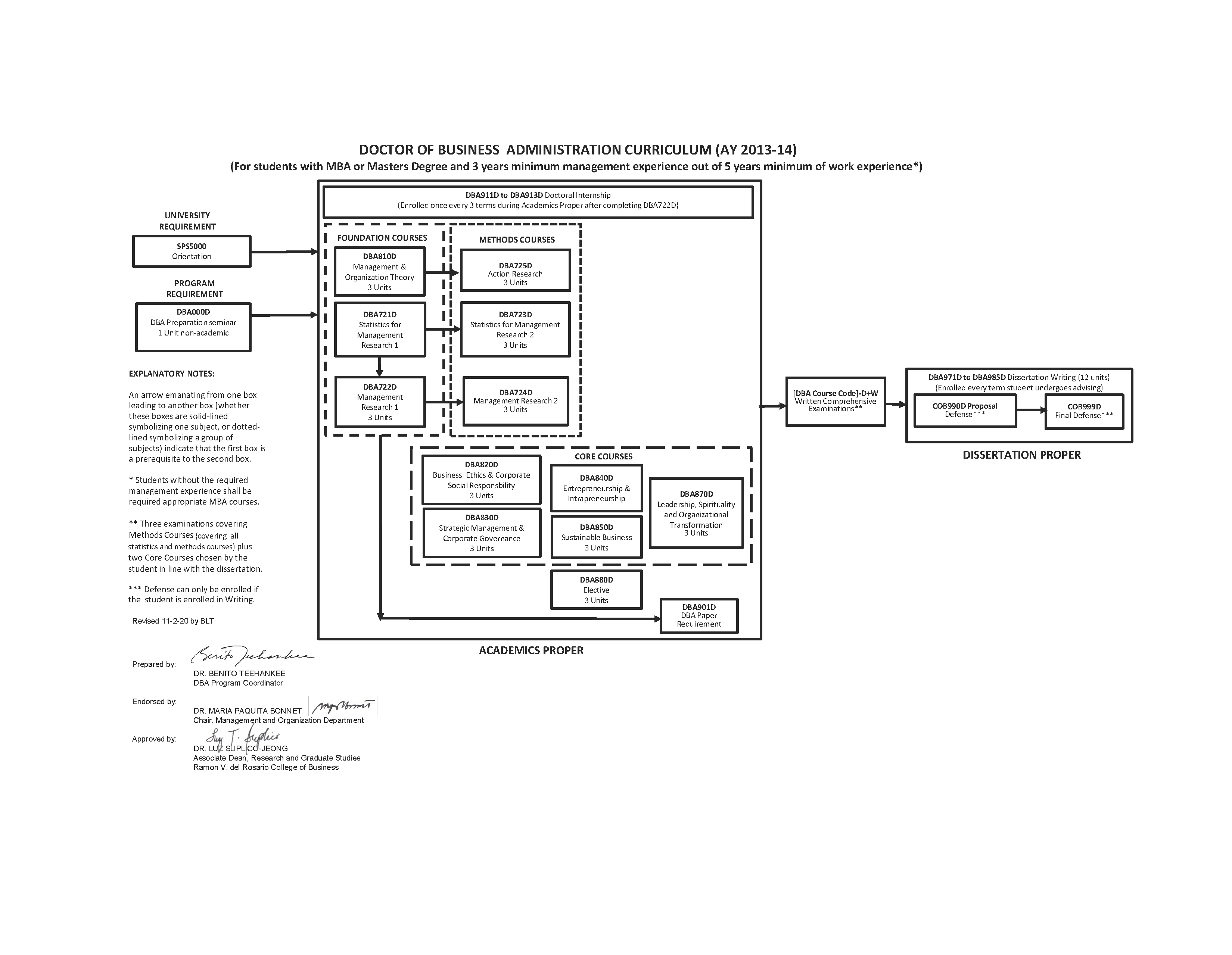
Click image for larger view
Contact Information
Office of Admissions and Scholarships (OAS)
Second Floor, Henry Sy, Sr. Hall De La Salle University 2401 Taft Avenue
1004 Manila, Philippines
Tel. Nos:
(632) 523-4230 (Direct) or 524-4611 to 19 local 166
Office Hours
Mondays to Fridays: 8:00 am – 12 noon; 1:30 pm – 5:00 pm
Saturdays: 8:00 am – 12 noon only
E-mail: [email protected]
Website: Graduate Studies Admission
Post-Graduate Diploma in Management
Post-Graduate Diploma Program in Management
The Post-Graduate Diploma Program in Management is designed for young professionals who are seeking management careers in business and industry. The learning-centered program prepares participants who want to earn a master’s degree in management, business and related fields. It is IT-driven, with online learning support, and focuses on management principles, utilization of management problemsolving and decision-making tools, and acquisition of skills.
Vision
To be a world-class graduate school of management inspired by Lasallian values and working with society to make a difference in people’s lives.
Mission
To develop outstanding professionals and entrepreneurs who exemplify humanistic value and are socially responsible stewards and change agents.
Admission Requirements
An applicant must have:
A bachelor’s degree from a governmentrecognized institution
Satisfactory admission test scores
Satisfactory interview and essay results
At least one year of relevant work experience
Program Structure
| Course | No. of Units |
| Business Communication | 3 |
| Management Principles | 3 |
| Business Law | 3 |
| Financial Accounting | 3 |
| Business Economics | 3 |
| Lasallian Business Leadership, Ethics, and CSR | 3 |
| Management Action Research | 3 |
| Quantitative Methods for Decision Making | 3 |
| Management Accounting | 3 |
| Total | 27 |
List of Requirements
For Local Applicants
1. Application Form with 2”x2” picture.
2. Original copy of Transcript of Records
3. Original Copy of NSO Birth Certificate
4. Transfer Credential (for non-DLSU graduate)
5. Two (2) Letters of recommendation (downloadable at DLSU website)
6. Updated Curriculum Vitae/Resume
7. Personal Statement containing Academic and Career Objectives
8. Two (2) pieces of 2”x 2” picture for testing permit
9. Certificate of good moral character from previous school/employer at least six months from date of issuance
10. Photocopy of research output (for Ph.D. applicants only)
For International Applicants
1. Application form with 2″x 2″ picture (downloadable at DLSU website)
2. Photocopy of passport
3. Two (2) copies of Transcript of Records (Authenticated and Original copy)
4. Certificate of Graduation (with degree title and date of graduation)
5. Two (2) copies of Certificate of No Criminal Record (Authenticated and photocopy)
6. Two (2) Letters of Recommendation (form downloadable at DLSU website)
7. Curriculum Vitae or Resume
8. Personal Statement (format can be viewed from the DLSU website)
9. Photocopy of Research output (For PhD applicants only)
10. Two (2) pieces 2″x2″ recent picture for testing permit
Flowchart
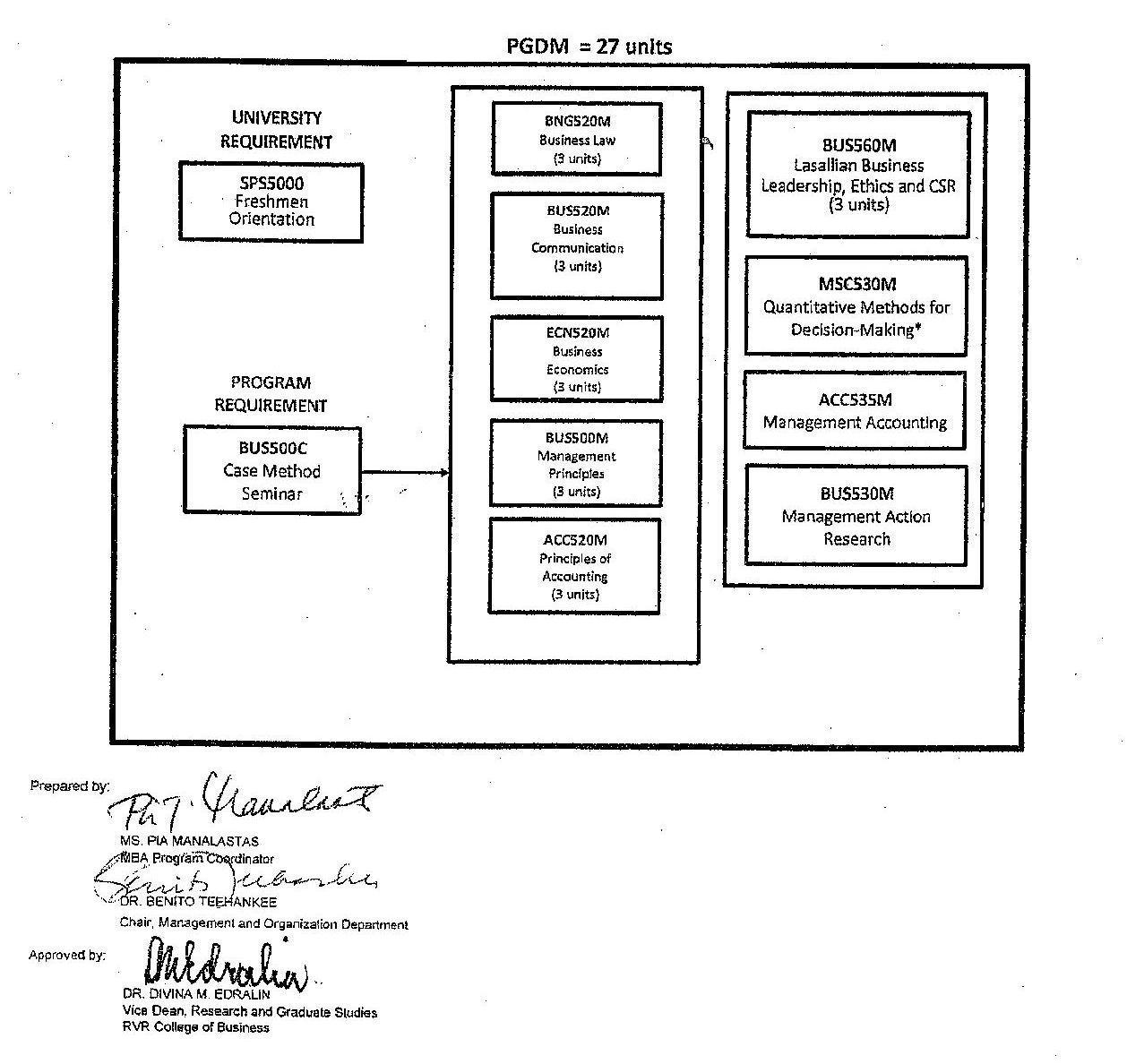 Click to View Flowchart
Graduate Admissions Office (GAO)
LS Hall Rm. 101
De La Salle University-Manila
2401 Taft Ave, Manila 1004, Philippines
Telephone Number:
Trunk line (632) 524-46-11 local 468
Direct line (632) 303-13-78
E-mail: [email protected]
Website: www.dlsu.edu.ph